The Creator Feedback Loop
What if the people teaching us how to build an audience are building their audience by teaching us how to build one? A look at the creator feedback loop, where attention becomes authority and the audience becomes the proof.
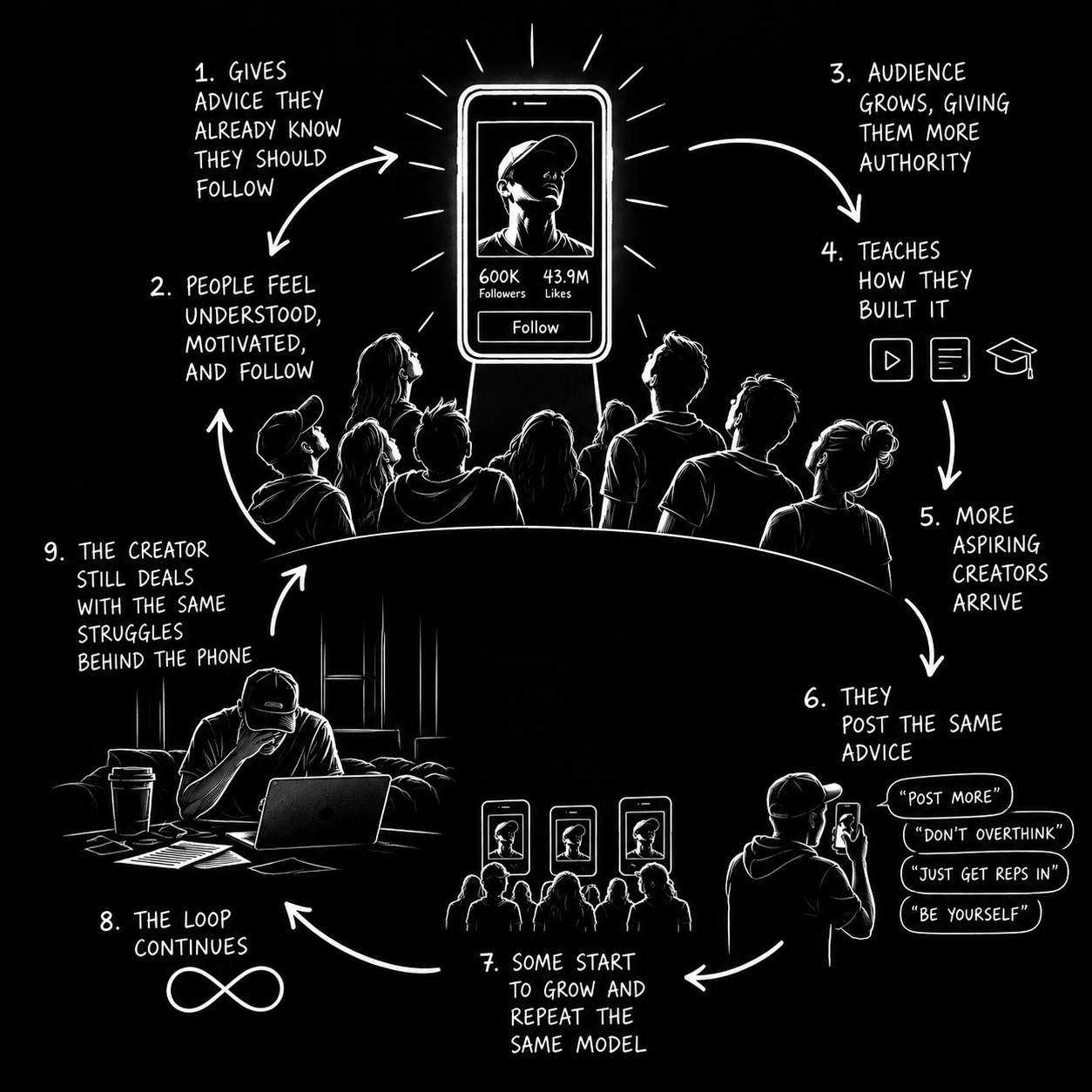
Building a following these days might be easier than we think.
Not because creating something valuable is easy.
But because there is an enormous audience of people who already know what they should be doing and are looking for someone to keep telling them to do it.
Take content creation.
You could build an entire platform saying:
Post more.
Stop caring what people think.
Stop overthinking it and get your reps in.
Stop making excuses.
Document your life.
You don’t need better lighting.
You don’t need better audio.
You don’t need the perfect background.
Stop chasing trends.
Be unapologetically yourself.
And none of that is necessarily bad advice.
Some of it is great advice.
But here’s the question I can’t stop thinking about:
Why do we keep consuming the advice instead of eventually leaving and doing it?
Maybe because the content is solving a different problem than we think.
It isn’t just teaching us.
It’s motivating us.
It’s validating us.
It’s reminding us of the person we want to become.
And that creates an incredibly powerful feedback loop.
The creator tells aspiring creators what they already know they need to do.
Those people feel understood, so they follow.
The creator’s audience grows.
That growth gives the creator more authority to talk about growing.
So more aspiring creators follow them.
Eventually the size of the audience itself becomes proof that the advice works.
But there’s something strange about that proof.
The audience being used to validate the advice is made up largely of people still trying to accomplish the thing the creator is teaching them to accomplish.
That doesn’t automatically make the creator dishonest.
They may not even realize it’s happening.
The algorithm tells them what works.
So they double down.
“Post more” gets views?
Make another video about posting more.
“Stop caring what people think” gets shares?
Make another one.
Eventually you can build an enormous platform around helping people build enormous platforms.
And then some people package the same ideas into courses and sell them.
But what happens to the person watching?
If the primary example of success they’re given is the person teaching them how to become a creator, the easiest path to replicate that success becomes…
Teaching other people how to become creators.
Now the loop reproduces itself.
Creator teaches aspiring creator.
Aspiring creator becomes creator.
New creator teaches aspiring creators.
And somewhere in that chain I think we have to ask:
What are we actually creating?
That’s where substance matters.
If you’re a carpenter, show me what you build.
If you’re a real estate advisor, help me understand real estate.
If you’re a filmmaker, make films.
If you’re a theologian, teach Scripture faithfully.
If you’re an entrepreneur, build something that solves a real problem.
Your following can amplify your expertise.
Your following should not automatically become your expertise.
And if we recognize this feedback loop, I think we have a responsibility to operate differently.
I don’t have your blueprint.
I don’t know your calling.
I don’t know your business.
I don’t know your goals.
And pretending I do just because I figured out how to hold your attention would be dishonest.
What I can do is tell you what I’m learning.
I can show you what worked for me and what didn’t.
I can explain the psychology behind a hook instead of pretending the hook is magic.
I can tell you why authoritative language holds attention instead of using authority to make you believe I know more than I do.
I can admit when something is designed for retention.
I can shine the spotlight on people doing meaningful work instead of constantly pointing it back at myself.
And maybe we can become okay with slower growth when that growth is attached to something real.
Because hooks work.
Storytelling works.
Authority works.
Editing works.
Retention tactics work.
Psychology works.
There’s nothing inherently wrong with learning any of them.
The question is what we’re using them to amplify.
I don’t want to become great at convincing you that I can teach you how to build something.
I want to actually build something worth amplifying.
And maybe that’s the test:
If the algorithm disappeared tomorrow, what would be left of your authority?