Content Is Exhausting
We were told content creation would give us freedom. But somewhere between the hooks, algorithms, posting schedules, view counts, and calls to action, I started wondering if we just built ourselves another rat race. What happens if we stop trying to become content creators and simply start creating again?
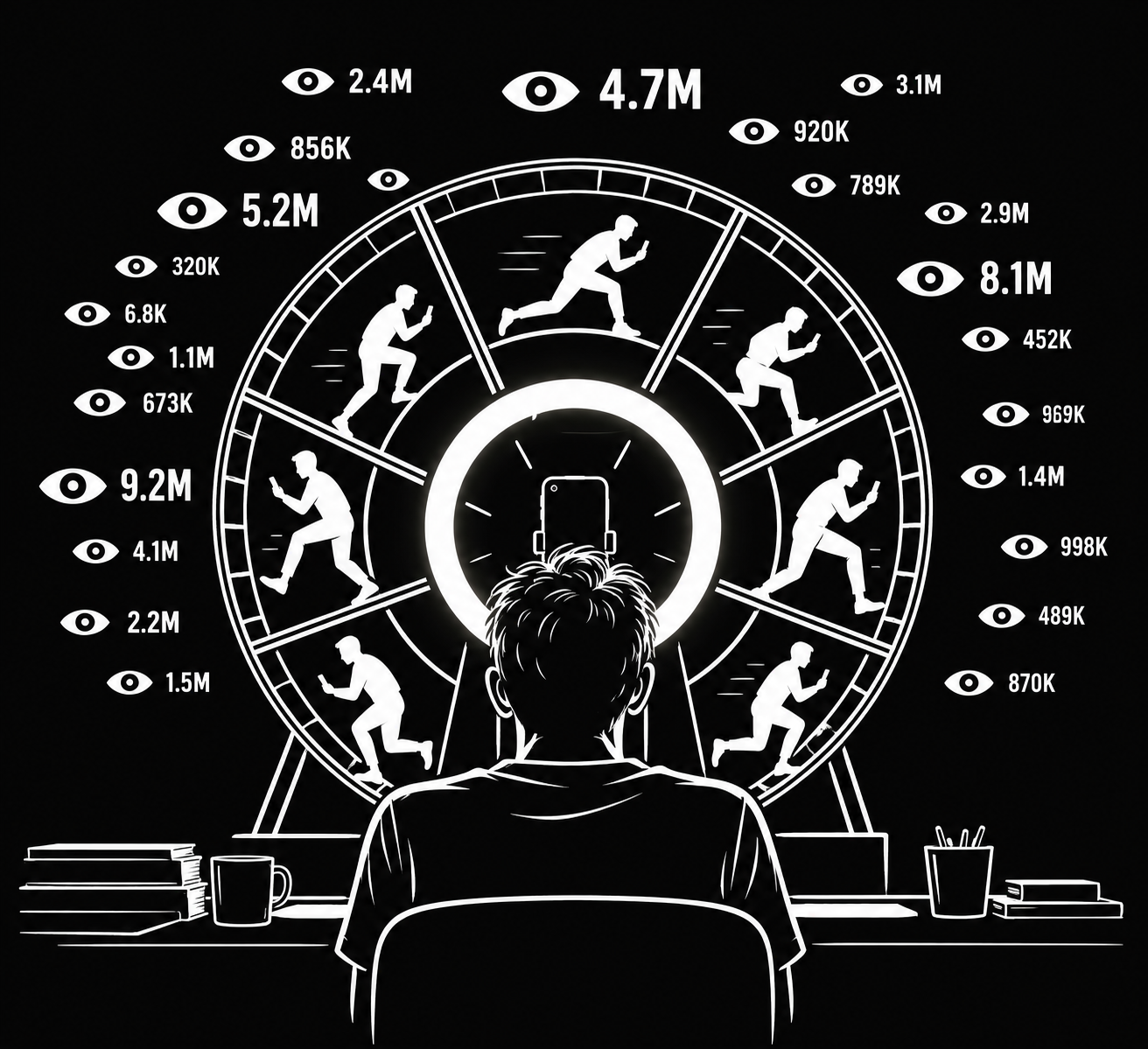
Most people think they want to create content.
It seems easy at first.
Grab a camera. Buy a ring light. Get a decent microphone. Turn it on and speak your mind.
If only it were that easy.
Spend enough time scrolling social media and you will quickly realize there is an entire psychology behind becoming “good” at content creation.
People have built entire businesses teaching other people how to do it.
What’s your hook?
Are your subtitles big enough?
How quickly should the words appear on screen?
Should you remove every pause between sentences?
How long should the video be?
What should the cover look like?
Should you write a script?
Where should you look?
When should you post?
How often should you post?
What’s your call to action?
And it goes on and on.
Eventually, you are not just trying to communicate an idea anymore.
You are trying to engineer attention.
Now you have to worry about whether someone will stop scrolling within the first second. You need to keep their attention long enough to finish the video. Then, before they leave, you are supposed to tell them what to do next.
Follow.
Comment.
Share.
Buy.
Subscribe.
Or, as we call it, a “call to action.”
But here is something I keep wondering:
How much action is actually happening?
How many people watch a video about changing their life and then simply swipe to another video about changing their life?
How many hours are spent learning about productivity instead of producing?
Learning about fitness instead of exercising?
Learning how to build a business instead of serving a customer?
Learning how to create content instead of actually having something worth saying?
If we looked closely enough, I wonder if we would discover that much of the attention economy produces exactly what it needs most:
More attention.
So how productive is all of this really?
And what would happen if we simply stopped following the rules?
That question interests me because, either way, content can become complicated.
There is an entire economy surrounding the idea of becoming a creator.
Courses.
Coaches.
Equipment.
Software.
Editing tools.
Analytics.
Algorithms.
Growth strategies.
People teaching people how to teach other people.
Sometimes I wonder how different parts of the creator economy really are from other opportunity systems we have seen throughout history.
Who consistently makes the money?
The creator?
The person teaching creators?
The software company selling creators tools?
The platform selling the attention creators produce?
Maybe there are good answers to those questions.
But I think they are worth asking.
Especially for normal people.
People who aren’t trying to become famous.
People who have families.
Jobs.
Businesses.
Churches.
Friends.
Neighbors.
Actual lives happening when the camera is turned off.
At what point does documenting your life begin replacing living it?
And if you do become successful at content creation, then what?
Do you ever get to stop?
If your income depends on attention, what happens when the attention disappears?
If your identity becomes attached to relevance, how much freedom do you really have?
These aren’t hypothetical questions for me.
I struggle with this.
Sometimes I tell myself I am going to make five videos a day.
Then it becomes one.
Then sometimes I disappear for a month.
What happened?
Usually, somewhere along the way, I decided the juice wasn’t worth the squeeze.
The process became heavier than the reason I wanted to create in the first place.
I started thinking about hooks instead of ideas.
Retention instead of conversations.
Algorithms instead of people.
And eventually the easiest thing to do was nothing.
I don’t think content creation is evil.
I don’t even think most of the advice is necessarily wrong.
If you want someone’s attention, it makes sense to learn how communication works.
But I do think there is much more to dedicating yourself to being a “content creator” than meets the eye.
You can escape one rat race only to build another one around yourself.
You can leave a job because you don’t want someone telling you what to do, only to spend your days allowing an algorithm to tell you what to say, how to say it, how long to say it, and how often you need to say it.
That doesn’t sound much like freedom either.
So maybe there is another way.
Create because you have something worth sharing.
Create because you are curious.
Create because you want to document something that matters.
Create because you want people to understand how you think.
Create because something helped you and you think it might help someone else.
Make money from it if the opportunity comes.
Learn the craft.
Get better at communicating.
But don’t let the machine become the reason you create.
And maybe instead of constantly fearing becoming irrelevant, we could treat creation more like art.
Say something when you have something worth saying.
Document things worth remembering.
Share things you genuinely believe are valuable.
Then turn the camera off.
And go live the life you were so determined to tell everyone about